One pass. Every age rating.
In summer 2026 I started building DCProof, a toolkit for the DCP workflows of sales houses.
But the market kept asking a different question: is this trailer or this ad fine for a 6-year-old, a 12-year-old, or only for adults?
Today that answer comes from a rating agency that doesn't explain itself, or from gut feeling.
A cartoon sword fight and a realistic stabbing are both "violence". They land in very different buckets.
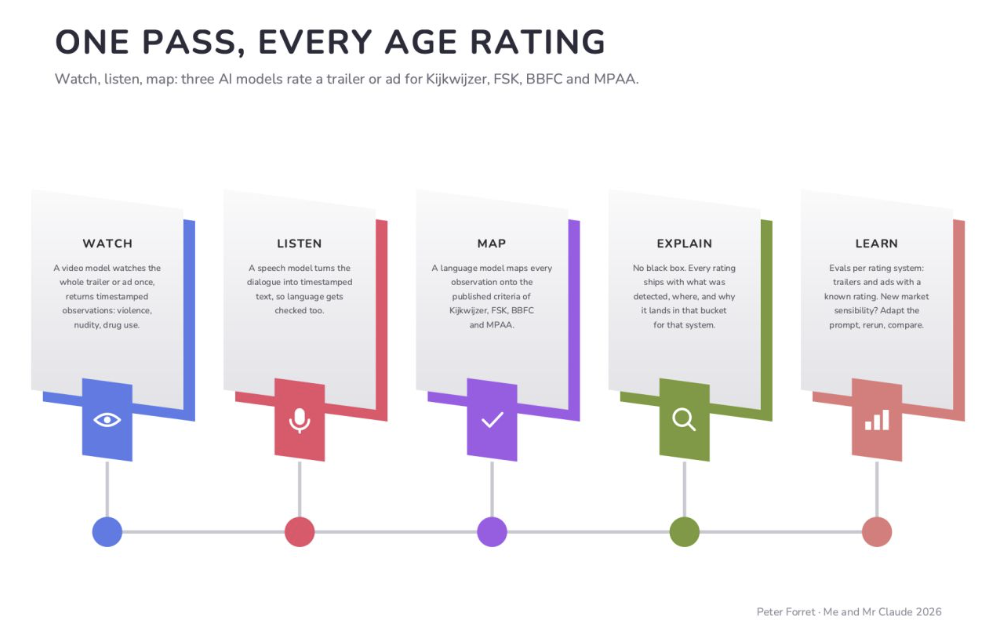
Watch, listen, map
So age rating became the focus, built around one method, "watch, listen, map":
- A video model watches the whole clip and returns timestamped observations.
- A speech model transcribes the dialogue for language checks.
- A language model maps each observation onto Kijkwijzer, FSK, BBFC and MPAA criteria.
Claude Code built the whole workflow with me: the model calls, the timecodes that tie picture and dialogue together, the mapping onto each rating system.
Keeping it right is the work
But the first rating is the easy part. Keeping it right is the work.
So every rating system has its own evals: reference trailers and ads with a known rating. Markets judge differently: swearing that earns a Kijkwijzer language pictogram won't raise a Swedish rating. So the mapping prompt adapts per market, and the evals run again. Claude Code runs that loop with me: adjust, rerun, compare.
Two years ago this would have been a research project. This summer it became three models and a working prototype.
No black box
The part I am proudest of: none of it is a black box. Every rating comes with what was detected, where, and why it lands in that bucket for that system.
One pass, every rating, and a reason for each.
How does your team rate video today: an agency, gut feeling, or nothing? Join the conversation on LinkedIn